01 — The basic differenceWhat are Egger boards and what sets them apart?
When we say "Egger boards", we mean laminated panel materials made by the Austrian manufacturer Egger — one of Europe's leading producers in the wood-based panel industry. These are chipboard or MDF panels with a laminate surface that replicates the look of wood, stone, metal, or concrete.
Standard boards — available from cheaper manufacturers or imports of unknown origin — do not offer the same level of thickness control, core density, or edge quality. The difference may not be visible in a photo, but you will notice it immediately in use.
02 — Density & stabilityWhy does the board's core matter?
The core — the material beneath the laminate surface — directly affects stability, moisture resistance, and cutting precision. Cheap boards often have uneven density, which means elements can warp, especially larger horizontal parts (long shelves, tall unit sides).
Egger uses standardised core densities that ensure every element holds its shape without deformation and that edges can be finished cleanly — which is especially important wherever edges are visible.
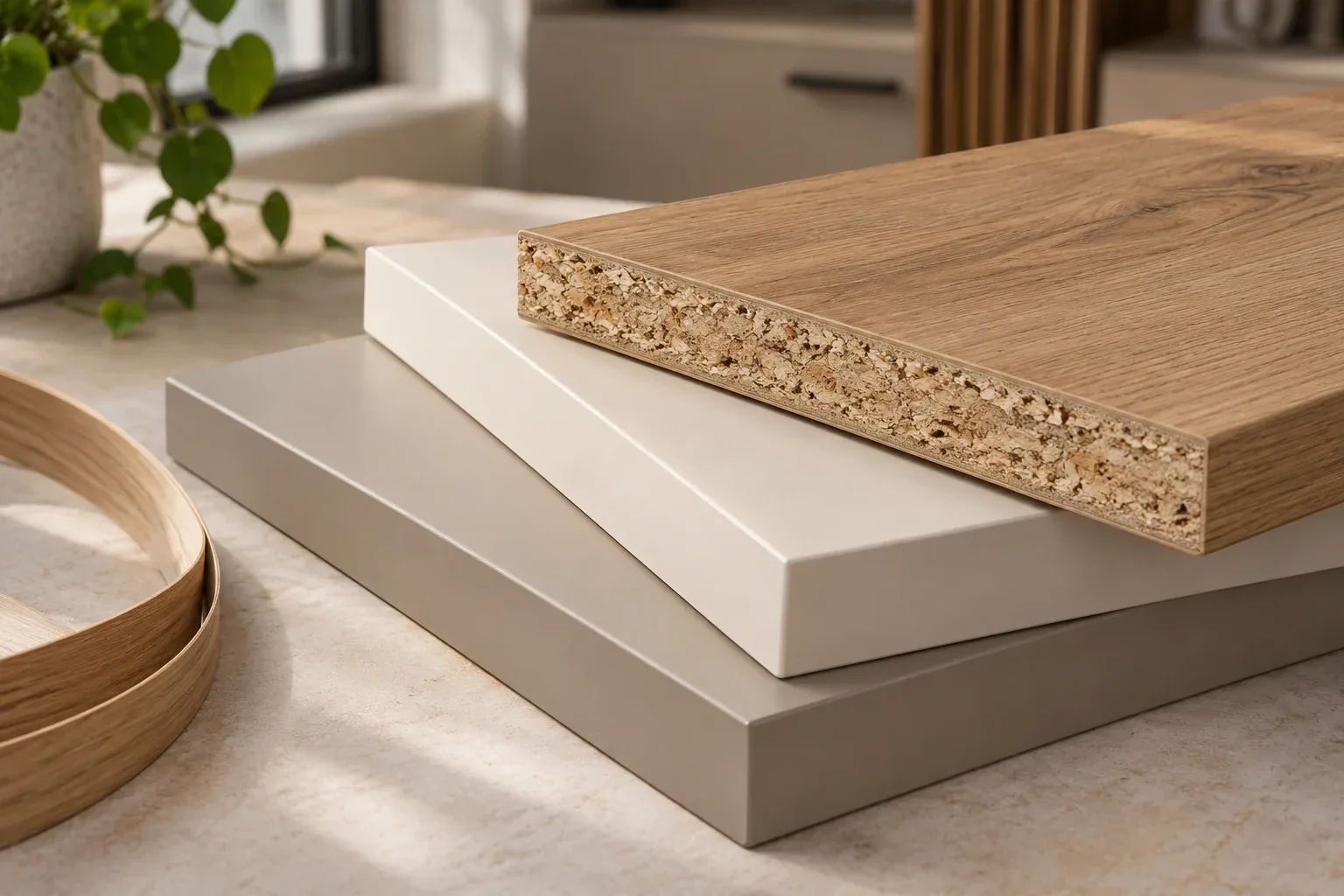
AI illustration of furniture board cross-sections and surfaces.
03 — Edge bandingEdges are where you see the difference
The edge of an element — the thin ABS edge strip applied to the cut side of the board — is where quality is easiest to spot. Poorly finished edges peel off, let water in, and visually undermine the entire kitchen's appearance.
As standard we use ABS edging that is machine-glued to the board — a firm, clean joint that seals the edge and protects it from moisture, which matters in a kitchen. A laser edge, with an almost invisible joint, is available on request.
Standard or laser edge?
A standard edge is glued on and, when properly applied, lasts for many years. A laser edge has a special functional layer that is melted onto the board, so the joint is almost invisible. Laser edging costs more and is available on request.
04 — ResistanceResistance to moisture, scratches, and heat
The kitchen is a room with extreme conditions: cooking steam, water splashes, dropped objects, contact with hot pots on the worktop. The material must withstand everyday use without visible deterioration.
Moisture
The laminate surface of Egger boards does not absorb water, but the chipboard core is not waterproof. What matters is that every edge is sealed with edging and the joint around the sink is properly sealed — we pay particular attention to this in the units under the sink and next to the dishwasher.
Scratches and impacts
The laminate surface of Egger boards has a high scratch resistance. This means everyday contact with cookware, placing objects down, and wiping will not leave visible marks in the short term.
UV stability
Egger decor colours do not fade in sunlight — the pigments are stable even under direct light. Particularly important for kitchens with large windows or those exposed to natural daylight throughout the day.
If you are planning a kitchen for long-term use (your own home, not a rental investment), Egger materials are the standard we recommend without reservation. The price difference compared to cheaper alternatives is smaller than most buyers expect — while the difference in durability is significant.
05 — Decor collectionAvailable decors and styles
Egger offers one of the widest decor collections in Europe — from realistic wood reproductions (oak, walnut, ash) to neutral tones (white, grey, anthracite), stone, and concrete. This means you have design freedom without compromising on material quality.
At NEST Studio we work with the current Egger collection and can show you physical samples in our showroom or send material sample cards by post or courier if you are abroad.
06 — ConclusionIs the price difference worth it?
The difference between Egger and cheaper alternatives in the total kitchen price is not dramatic — we are talking about 5–15% of the overall cost, depending on the project. But the difference in durability, appearance, and feel after 10 years is clearly visible.
A kitchen is a long-term investment in everyday comfort. The material you choose determines how it will look and perform in one year, five years, and ten years. That is why it makes no sense to cut costs on materials if you plan to stay in the space for more than a couple of years.